Advanced Logic
Table of Contents
Transforming and constructing models
Disjoint union of models: combine models by union of states, relations, and valuations. A state in one of the models is modally equivalent with the state in the union.
Generated submodel: starting from state w, only take its future.
Tree unraveling
Tree unravelling: unravelling of world s in (W,R,V) is:
- $W’ : (s_{1} \dots s_{n})$ with $s_{1} = s$ and $Rs_{i} s_{i+1}$
- $R’$ relates ($s_{1} \dots s_{n}$) to ($s_{1} \dots s_{n+1}$) if $Rs_{n} s_{n+1}$
- $V’(p) = { (s_{1} \dots s_{n} | s_{n} \in V(p) }$
- a state in (W’,R’,V’) is bisimilar to $s_{n}$ in (W,R,V)
- if φ is satisfiable in M,w it is satisfiable in tree unravelling of s in M
Basically taking the states with possible paths between them, and drawing a tree.
Example:
| Model | Tree unraveling |
|---|---|
|
Graphviz code |
Graphviz code |
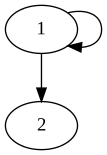
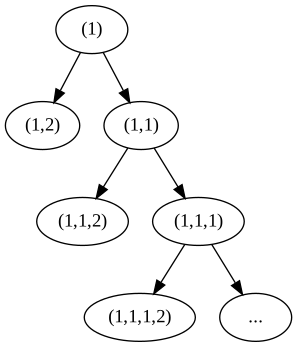
If two trees have the same structure, the models are bisimilar.
Model contraction
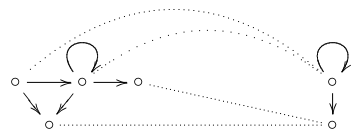
Bisimulation contraction
- W’ consists of equivalence classes |s| = { t such that $s \underline{\leftrightarrow} t$ }
- R’ relates |s| to |t| if Ruv for some u ∈ |s| and some v ∈ |t|
- V’(p) = { |s| | s ∈ V(p) }
Basically getting rid of ‘unnecessary’ states. See in this diagram, model on the left and contraction on the right:
Validity and satisfiability
If φ is satisfiable, then it is satisfiable using a model with at most $2^{s(\phi)}$ elements with s(φ) the number of subformulas of φ.